

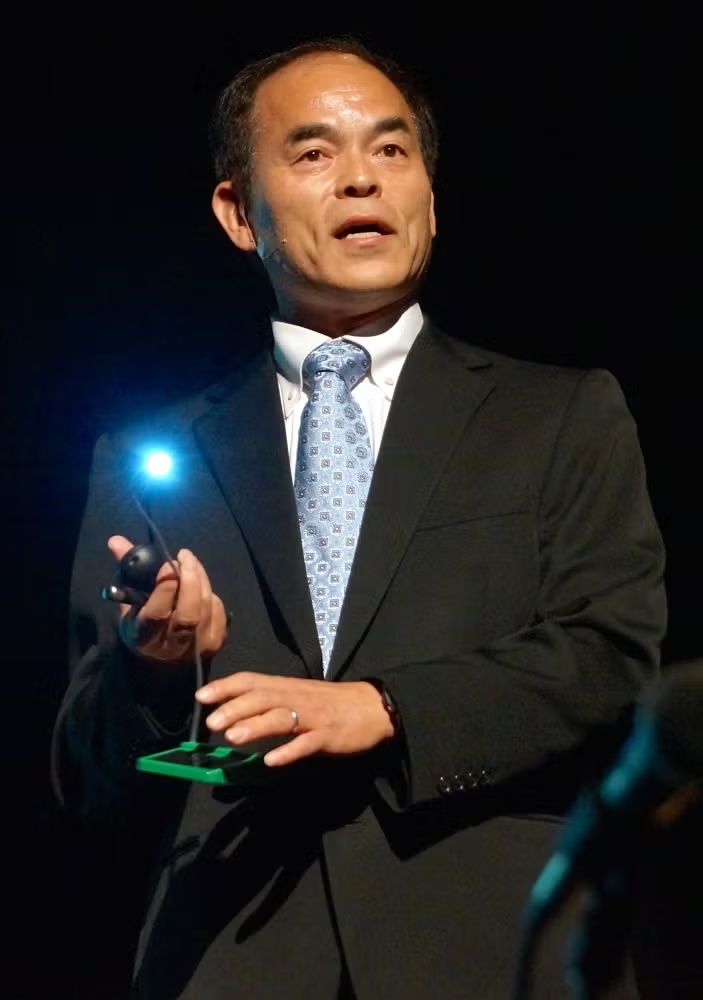
Thomas Edison died in 1931 but the final nail in his coffin was hammered in place in 1993 when Shuji Nakamura invented the high-brightness blue light-emitting diode (LED). This accomplishment would in turn make possible the bright white LED and forever change the way we light the world.
Nakamura didn’t invent LEDs — that was first accomplished in 1962 when GE invented the visible red-light LED at a laboratory in Syracuse, NY. Red-light LEDs were quickly commercialized and other colors followed, but scientists remained unable to conquer the challenge of the efficient, high-brightness blue LED.
In 1979, nearly two decades after GE’s initial discovery, Nakamura joined a small chemical manufacturing company in Japan, known as Nichia. After years of working on Nichia’s research and development team with only limited commercial success, Nakamura convinced the company’s president to let him focus primarily on the blue-light LED problem. Nakamura would eventually zero in on the relatively understudied semiconductor material gallium nitride, ultimately paving the way for his 1993 breakthrough.
Bob Johnstone wrote in his book Brilliant!: Shuji Nakamura and the Revolution in Lighting Technology that the invention was “100 times brighter than commercial silicon-carbide blue LEDs, bright enough to be seen in broad daylight.”
Even before Nakamura cracked the code of the blue-light LED, the underlying technology was being used in vehicle and specialized outdoor signage applications, replacing the old filament-burning bulbs of the last century. A key advantage was that LEDs could produce comparable light using as little as one-tenth the electricity of incandescent bulbs.
Emitting blue light was the last substantial barrier in the decades-long development of LED technology, and once this hurdle was cleared the stage was set for the humble light-emitting diode to sweep the globe.
By 2010 the total LED market amounted to an estimated 50 billion individual LED components annually with current yearly production potentially surpassing 500 billion.
The U.S. Department of Energy estimates that LEDs now save Americans more than $20 billion annually in avoided energy costs. These savings are equivalent to roughly 6% of total annual U.S. electricity use by homes and commercial buildings.
And the LED shows no signs of stopping, as global market size is forecast to top $115 billion in 2026 and grow to $200 billion by 2033.
In 2000 Nakamura joined the faculty at UC Santa Barbara, where he has now been a professor for over 25 years.
In 2006 he was awarded the Millennium Technology Prize, and in 2014 the Nobel Prize for Physics.
Though Nakamura has achieved the highest recognition possible from among his scientific peers, he is still relatively unknown to the general public.
It is for this reason that I believe it is appropriate for the City — or County — of Santa Barbara to erect a statue to Nakamura, name a park after him or create some other public tribute to him.
Nakamura has said, “The University of California has a motto; the English translation is ‘Let there be light.’ This is a very good motto for our university. It also could serve as a motto for my own research.”
And someday the world might add, “… and we saw the light, and it was good.”
John Hunt,
Camarillo


